The doldrums

Back after the break, and my life isn’t really that hard these days. Nonetheless I and everyone around me seem exhausted. No one knows what to blame; it feels, over the days, most like a collection of small things: the weather, the death of a not-very-well-known colleague’s son, the shorter-than-usual break, the MLA, 10 days without daycare, a lack of exercise, two job searches, one of which turned out to be emotionally very difficult.

None of these amounts to anything on its own. In a list they together don’t amount to much either.

This is the shape of a first-world, rich-person problem, I know. Too mild to be depression, it’s why the Cheever characters swim through strangers’ pools, why everyone on Mad Men is perpetually lubricated, why I am feeling snappish and dull.

First step: get back to writing and working. The communists were at least right about that, for me.

Posted in Uncategorized | Comments Off on The doldrums

U of Chicago / Feb 7, 2013

I’ll be giving a new talk, using some material from Becoming a Writer, at the University of Chicago in early February. Title: “Academic Writing, I Love You. Really, I Do.” Event organized by the devastating Lauren Berlant.

This will be my first attempt at a new format: a series of episodes, quotations, aphorisms, or short commentaries, all written on index cards, which are shuffled before the talk and then read in whatever order they appear in. I may cheat, B.S. Johnson-style, by determining in advance the first and last cards; or I may leave things to fate.

I’ll post the cards here after the talk.

Posted in Ephemera | Comments Off on U of Chicago / Feb 7, 2013

Yale / Jan 31-Feb 1, 2013

I’ll be giving two seminars at Yale later this month. The first, for the Theory & Media colloquium, is on On Literary Worlds (Thursday Jan 31, 4pm); the second, Friday at noon, is a discussion of scholarly writing. Students will be reading excerpts from OLW and from the newest project, Becoming a Writer, whose manuscript I’ve just completed.

Events organized by Jordan Brower and R. John Williams.

Posted in Ephemera | Comments Off on Yale / Jan 31-Feb 1, 2013

Jameson’s similes

This is a list of most of the similes using “like” in Fredric Jameson’s Postmodernism.
The prestige of these great streamlined shapes can be measured by their metaphorical presence in Le Corbusier’s buildings, vast Utopian structures which ride like so many gigantic steamship liners upon the urban scenery of an older fallen earth. (36)
It strikes one then, in that spirit, that neofigurative painting today is very much that extraordinary space through which all the images and icons of the culture spill and float, haphazard, like a logjam of the visual, bearing off with them everything . (176; love the echo of the last line of Gatsby!)
Only an old-fashioned communism and an old-fashioned psychoanalysis stood out upon the agrarian landscape like immense and ugly foreign bodies, history itself (equally old- fashioned  in those days) being very effectively consigned to the dusty ash can of “scholarship.” (183-84)
I think we now have to talk about the relief of the postmodern generally, a thunderous unblocking of logjams and a release of new productivity that was somehow tensed up and frozen, locked like cramped muscles, at the latter end of the …(313)
Like the three wishes in the fairy tale, or the devil’s promises, this prognosis has been fully realized, with only the slightest of modifications that make it unrecognizable. (320)
…at one and the same time more abstract and more concrete, and a feature whose essential materialism can be measured by its scandalousness for the mind, which avoids it or hides it away like plumbing. (356; this one especially good because it’s such a surprise, and doesn’t explain itself)
inward conceptual defense mechanisms, and in particular the rationalizations of privilege and the well-nigh natural formations (like extraordinary crystalline structures or coral formations excreted over millennia) of narcissism and self-love…(358)
It would now seem that, far from becoming extinct, the older genres, released like viruses from their traditional ecosystem, have now spread out and colonized reality itself… (371)
We have all those things, indeed, but we jog afterward to refresh the constitution, while by the same token computers relieve us of the terrible obligation to distend the memory like a swollen bladder retaining all these encyclopedia references. (383)
And here is my favorite Jamesonian simile of all, from The Political Unconscious:
Only Marxism can give us an account of the essential mystery of the cultural past, which, like Tiresias drinking the blood, is momentarily returned to life and warmth and once more allowed to speak, and to deliver its long-forgotten message in surroundings utterly alien to it. (383)
Source: Printculture

Posted in Uncategorized | Comments Off on Jameson’s similes

Sitcoms of yesteryear

Among the more popular premises for a sitcom is the fish out of water. Under this general rubric you will find many of the long-running shows of the last fifty years, often organized around the classic social situations: race, class, gender, and sexuality.

Race: The Jeffersons, which was an offshoot of one of the original fish-out-of-water scenes, the loosely veiled but still basically racial All in the Family, whose theme song (“guys like us we had it made… those were the days. … do you remember way back when, girls were girls and men were men… those were the days”) made it clear that Archie Bunker’s biggest problem was that he was a fish out of time – but of course for white folks to be out of time is always to be out of “race” as well. (If you have six minutes watch this amazing clip where Archie, late in the show’s run, takes on the KKK and calls himself “black”.) (Also in this category: Family Matters.)
Class: Two Broke Girls, The Fresh Prince of Bel Air (not Roseanne; I’m talking about sitcoms where the basic premise is that someone is out of joint);  Sexuality/Gender: Three’s Company comes to mind (but not Will & Grace). Something like Modern Family seems to be trying to wrap all of these up in a single package (which is interesting, because it has to produce wholeness out of that incongruous mix, but of course, that’s the point.)
But none of these categories quite capture the strangeness of the science fictional sitcom, in which the fish is an alien and the new swimming pool is the planet Earth. It’s so strange I think it’s easy to forget that through the 70s 80s and 90s the alien-on-Earth was a basic premise for television comedy. Mork & Mindy for the 70s, ALF for the 80s; and Third Rock from the Sun for the 90s. (There was also Small Wonder (amazing!! theme song), but that was about a robot.)
I have almost nothing to say about this but to that the other night as I fell asleep I was overcome with the marvel of this kind of sitcom. Aliens yes, but aliens and comedy just doesn’t seem plausible. I mean, what a crazy thing, no? It seems totally unimaginable that such a show would be on television today. And so I found myself wondering what kind of culture we are that used to allow these shows, and now doesn’t. It could all just be random noise, of course, but the critical, close readerly demand for total necessity leaves me wanting more.
Source: Printculture

Posted in Uncategorized | Comments Off on Sitcoms of yesteryear

Republicans on Copyright


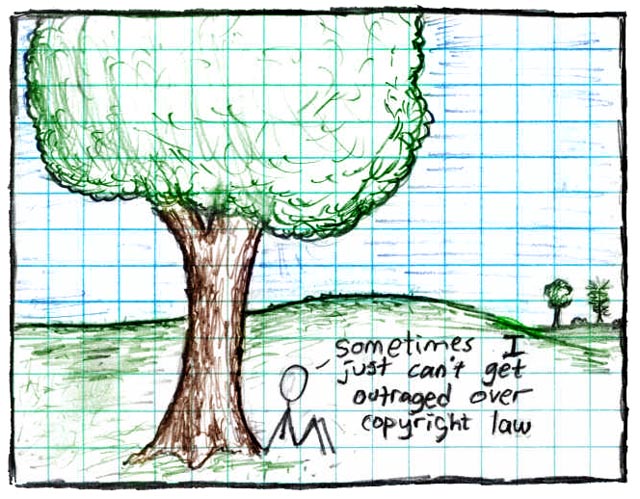
A few years ago at the instigation of Paul Saint-Amour Ted Wesp and I spent a few months thinking and writing about copyright (results in Paul’s edited book, here). Ever since I’ve been convinced not only of the importance of copyright for thinking about the history of aesthetic production, but also of its vital contemporary impact on the entire economic life-world, ranging from patent law (and its implications for technological or medical developments) to the field of culture.
Crooked Timber points me to the Republican Study Committee’s new thinkpiece on copyright, which argues against it from a radical capitalist/libertarian perspective. I am not going to read the entire RSC piece, and neither are you, so here instead is the quote CT pulls out:
Copyright violates nearly every tenet of laissez faire capitalism. Under the current system of copyright, producers of content are entitled to a guaranteed, government instituted, government subsidized content-monopoly … It is a system implemented and regulated by the government, and backed up by laws that allow for massive damages for violations. These massive damages are not conventional tort law damages, but damages that are vastly disproportionate from the actual damage to the copyright producer. … we do know that our copyright paradigm has … Retarded the creation of a robust DJ/Remix industry … Hampering scientific inquiry … Stifling the creation of a public library … Free 12-year copyright term for all new works – subject to registration, and all existing works are renewed as of the passage of the reform legislation. If passed today this would mean that new works have a copyright until 2024.
Ummm. Amen?
Source: Printculture

Posted in Uncategorized | Comments Off on Republicans on Copyright

Administrators and Professors

This piece in Bloomberg is disappointingly short. Money quote:
At universities nationwide, employment of administrators jumped 60 percent from 1993 to 2009, 10 times the growth rate for tenured faculty. “Administrative bloat is clearly contributing to the overall cost of higher education,” says Jay Greene, an education professor at the University of Arkansas. In a 2010 study, Greene found that from 1993 to 2007, spending on administration rose almost twice as fast as funding for research and teaching at 198 leading U.S. universities.
Again, the piece overall is a bit short. Would be nice to see some serious thinking about the causes of this shift (other than the aortic one).
Source: Printculture

Posted in Uncategorized | Comments Off on Administrators and Professors

More on MOOCs

Siva Vaidhyanathan on MOOCs, just to keep the discussion going.

If we support the MOOC experiment it would be foolish to do so without confronting the serious incentive problems MOOCs present to teachers, students, and institutions of higher education. These are not reasons to quit MOOCs. They are reasons to take them seriously and strive to maximize the rewards of MOOCs while curbing the perverse incentives.
We should offer MOOCs that aim for many levels of expertise and in many languages. We should not reward universities or faculty based on initial, inflated enrollment. We should question the “O” as in “open” because a flood of trolls is about to show up in MOOC discussions, threatening to ruin everyone’s best efforts. We should ask why universities are not hosting and launching their own homegrown MOOCs when the software is simple and the talent is all in-house. Why engage with private companies that have completely different missions and demands than universities do?

The piece as a whole reminds me of how difficult it is to have a conversation about teaching (or education more generally) that doesn’t immediately suck in all sorts of related problems (technological fundamentalism, corporatization, the adjunct problem, administrative bloat) that make universities today so complicated.
Source: Printculture

Posted in Uncategorized | Comments Off on More on MOOCs